There’s a moment every business owner hits. You need a website, you look at what a designer charges, and right next to it is a $20-a-month template builder or a free AI tool that promises to spin one up while you finish your coffee. The math looks obvious.
I’m not going to pretend it never is. If you’re testing an idea this weekend, or you need a one-page placeholder so people can find your phone number, go build it yourself. Seriously. Don’t pay me for that.
But “cheap and fast today” and “the right call for your business” aren’t the same thing, and the gap between them is invisible at the moment you’re deciding. The cost of doing it yourself doesn’t show up on day one. It shows up in month six, in the customers who never called, and in the Saturday afternoons you spent fighting a drag-and-drop editor instead of being anywhere else.
Here’s where that gap usually hides.
You don’t really get the design you want
The pitch is “fully customizable.” The reality is you get to pick from a menu. The template was built to look acceptable for a thousand different businesses, which means it was built to look like nobody in particular — including you.
That’s fine right up until you want to change something real. Move that section, change how the header behaves on a phone, make one thing actually stand out. Now you’re either stuck with “close enough,” or you’re an hour deep in a settings panel discovering that the one thing you want to change is the one thing the template won’t let you touch.
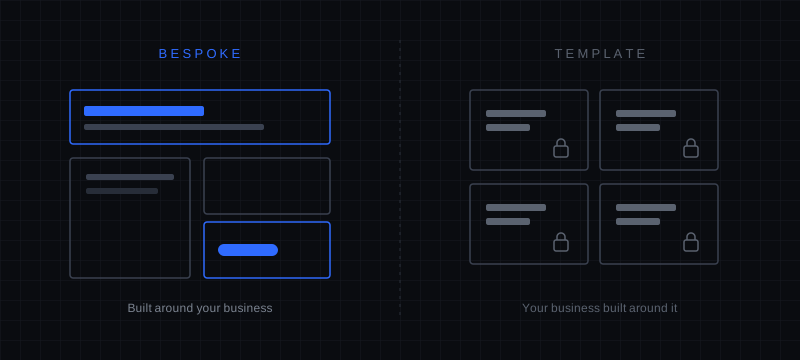
You end up shaping your business to fit the website instead of the other way around. For a contractor or a local shop, your website is your first impression now. “Close enough” is a strange place to set the bar for the thing standing in for you when you’re not in the room.
When something breaks, you’re calling a stranger
This is the part nobody warns you about. The site goes sideways — a form stops sending, a page won’t load, something looks wrong on mobile — and your only move is the support line.
So you call. You explain your whole situation to a person who has never heard of your business. They get you halfway there. Next week, different problem, you call again, and it’s a different person who also has no idea who you are, what your site is supposed to do, or what the last person told you. You’re starting from zero every single time.
There’s no one who actually knows your site. No one accountable for it. Just a rotating door of well-meaning strangers reading from the same script. When your livelihood is riding on this thing working, “open a ticket and wait” is a rough place to be.
“SEO included” is doing a lot of work in that sentence
Every builder advertises SEO and analytics. What they mean is they’ll fill in the basic fields and hand you a dashboard with some numbers on it. That’s the floor, not real visibility.
These platforms can’t go deep, and honestly they’re not built to. They can’t tell you which search terms your actual customers in your actual town are using, why a competitor two miles away is outranking you, or what to change to fix it. And increasingly the question isn’t even “do you rank on Google” — it’s “when someone asks an AI assistant for a good plumber near here, does your business get named, or does it get skipped for a directory?”
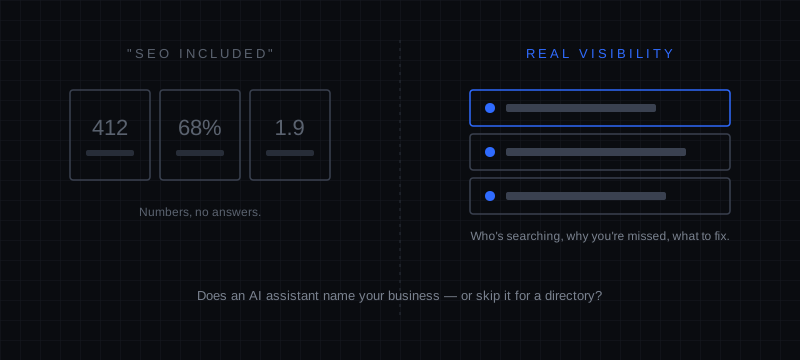
That’s a real divide opening up right now, and a template builder isn’t going to cross it for you. Whether an AI names your business or sends your customer to a directory comes down to machine-readable signals under the hood that these tools don’t build. (It’s the single most overlooked thing in local marketing this year — here’s the whole breakdown.)
You might not even own what you built
Read this part before you sign up anywhere. A lot of template platforms use proprietary layouts that don’t go anywhere. The site lives on their system, in their format. The day you outgrow them, or their prices jump, or they get bought and shut down, you can’t just pack up your site and move it somewhere else.
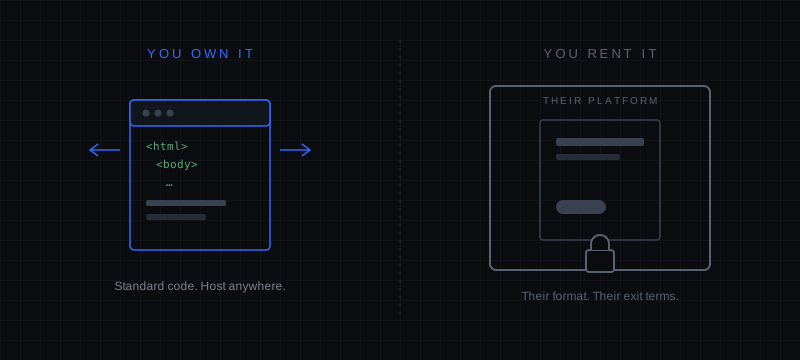
You were renting the whole time. You just didn’t see the lease. Compare that to a site built on plain, standard code that you own outright and can host anywhere — the difference doesn’t matter at all until the day it suddenly matters a lot.
Your time is worth more than the sticker price
Here’s the cost the builders never put on the page: yours.
Every hour you spend nudging boxes around, watching tutorials, and re-doing the thing that broke is an hour you didn’t spend somewhere it counts. On the jobsite. Writing the estimate that turns into a paying job. Following up with the lead from last week. Building the actual business.
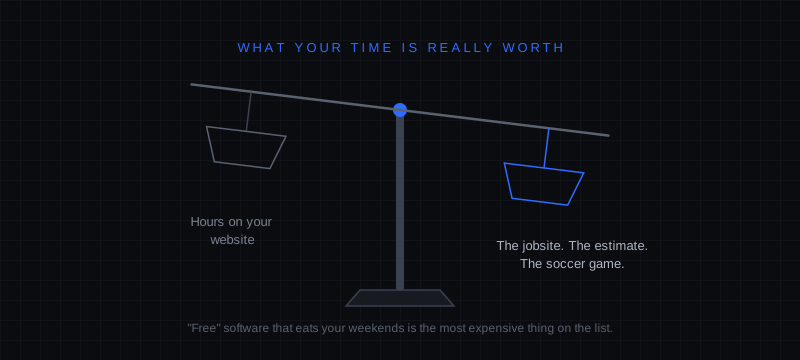
And that’s just the work side. The other side of that scale is your kid’s soccer game, dinner that isn’t eaten at a laptop, a Saturday that’s actually yours. “Free” software that quietly eats your weekends isn’t free. It’s the most expensive thing on the list — you just pay for it in the currency you can’t earn back.
That’s the real tax of doing it yourself. It was never really about the build. It’s that you’ve now signed up to be the permanent IT department for a tool you half understand, forever.
So when is DIY the right call?
I told you I’d be straight about this. Do it yourself when:
- You’re testing an idea and just need something live this week.
- It’s truly a placeholder — name, phone number, hours, done.
- The site genuinely doesn’t need to win you business; it just needs to exist.
- You actually enjoy this stuff and have the time to spare. (Some people do. No judgment.)
And think hard about getting help when:
- Your website is how customers decide whether to call you.
- You’re competing for the same jobs as everyone else in town and need to stand out.
- You’ve already got a DIY site and something feels off — it’s slow, it’s invisible in search, it doesn’t sound like you, or it just isn’t bringing in work.
- The hours you’re sinking into it are hours your business actually needs.
If you’re in that second list, the move isn’t “panic and start over.” It’s an honest look at what your site is supposed to do for you and where it’s falling short. Sometimes that’s a tune-up. Sometimes it’s a rebuild. Sometimes it really is “leave it alone, it’s fine.” I’ll tell you which one I think it is even when the answer is the one that doesn’t pay me.
Because the goal was never a website. The goal is the phone ringing. Everything else is just how you get there.
Wondering which list you’re in? If your current site is slow, generic, or invisible when someone searches your trade, that’s worth a look — no pitch, just a straight read on where you stand.
Or call/text: (717) 677-2502